UIXPulse Creative Agency

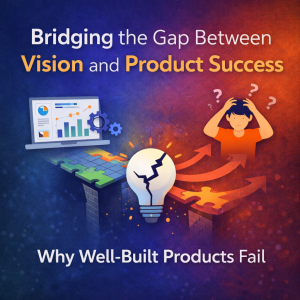
Why Well-Built Products Fail: The Missing Link Between Vision and Product Strategy

Many high-quality products fail despite great design and features. Learn how misaligned vision and product strategy lead to fragmented experiences and missed success.
What is Dark UX? (Dark Patterns in simple terms)

Why Do “Good” Products Fail to Succeed?

One of the most common questions in product management and SaaS development is:

Why do some products fail—even when they are well-designed, technically solid, and feature-rich?

In most cases:

  • The product team is capable
  • The UX design is not poor
  • The features are not illogical

Yet the product still:

  • Lacks cohesion
  • Has no clear direction
  • Feels like a collection of disconnected decisions

The problem is rarely execution.
The real issue is decision-making at the wrong layer.

The Root Cause: Decisions Without Strategic Anchors

In many product teams, we observe the same pattern:

  • Features are added incrementally
  • Each decision seems rational in isolation
  • Output quality remains high

But over time:

  • The product loses a sense of unity
  • The user journey becomes fragmented
  • The experience lacks guidance

👉 The product works
👉 But it does not lead

This happens when teams don’t know what each decision should connect to.

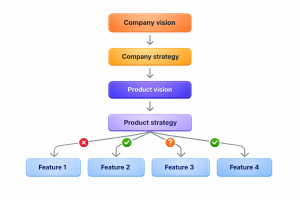
Every Successful Product Is Built on a Strategic Chain

Strong products are not built on random good ideas.
They are built on a clear, hierarchical decision structure.

1️⃣ Company Vision

  • Why does the company exist?
  • What change is it trying to create in the world?

The company vision defines the long-term direction.

2️⃣ Business Strategy

  • Which market are we competing in?
  • What is our competitive advantage?
  • What are we explicitly choosing not to do?

This layer defines how the company will reach its vision.

3️⃣ Product Vision

This is where strategy becomes user-centric:

  • What experience should the user have?
  • What problem should feel solved?
  • How should the product change the user’s behavior or mindset?

Product vision translates company goals into user outcomes.

4️⃣ Product Strategy

This is where real decisions happen:

  • What do we build?
  • What do we intentionally not build?
  • Do we prioritize simplicity or power?
  • Which trade-offs are acceptable?

📌 Every feature decision must trace back through this chain.

A Practical Example: When Vision Isn’t Translated

Imagine a company with this vision:

“High-quality education should be accessible to everyone.”

It sounds inspiring.
But without translation, it’s almost useless for a product team.

Translating Company Vision Into Product Vision

At the product level, that vision implies:

  • New users should not feel overwhelmed or intimidated
  • Starting to learn should require minimal friction
  • Progress should feel clear and predictable

Product Strategy Derived From That Vision

From this, clear strategic decisions emerge:

  • Simplicity is more important than advanced functionality

  • Onboarding is not a feature—it’s a core priority

  • Anything that introduces unnecessary complexity must be removed

This is what vision-driven product strategy looks like.

The Most Common Product Strategy Mistake

Here’s where many teams go wrong:

“Let’s add advanced features to make the product more powerful.”

Suddenly, the product includes:

  • Complex analytics dashboards
  • Heavy reporting systems
  • Advanced settings with little guidance

Product Strategy Derived From That Vision

From this, clear strategic decisions emerge:

  • Simplicity is more important than advanced functionality

  • Onboarding is not a feature—it’s a core priority

  • Anything that introduces unnecessary complexity must be removed

This is what vision-driven product strategy looks like.

The Most Common Product Strategy Mistake

Here’s where many teams go wrong:

“Let’s add advanced features to make the product more powerful.”

Suddenly, the product includes:

  • Complex analytics dashboards
  • Heavy reporting systems
  • Advanced settings with little guidance

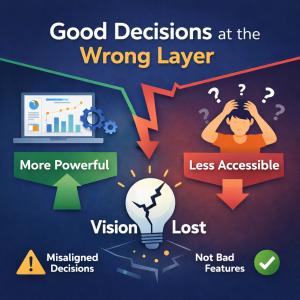
The Result: Good Decisions at the Wrong Layer

💥 What happens next?

  • The product becomes technically more powerful
  • But significantly less accessible to its core users

The product now actively contradicts its original vision.

📌 The issue isn’t bad features.
It’s misaligned decision-making.
Vision Should Drive Decisions—Not Just Inspire

A real vision must be actionable.
If it cannot be translated into:

  • UX design principles
  • Feature prioritization criteria
  • Clear “no” decisions

Then that vision has not entered the product.

Key Takeaway: Great Products Are Built on Correct Decisions

Successful products are not the result of:

  • More features
  • More ideas
  • More effort

They are the result of:
✔ Fewer but better decisions
✔ Made at the correct strategic layer
✔ Consistently aligned with vision

🧭 Products that follow this structure:
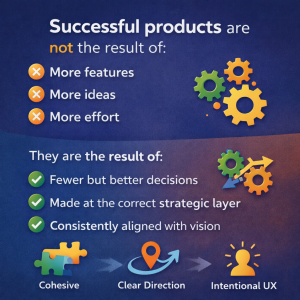
  • Feel cohesive
  • Have a clear direction
  • Create guided, intentional user experiences

Conclusion

Products Don’t Fail Because They’re Bad — They Fail Because They’re Unaligned

Most products don’t fail due to poor execution, weak teams, or lack of features.
They fail because their decisions are disconnected from their vision.

A product can be technically excellent, beautifully designed, and packed with capabilities—yet still feel confusing, fragmented, and directionless. When that happens, the root cause is almost always the same: decisions were made without a clear strategic anchor.

Great products are not built by adding more.
They are built by:

  • Translating company vision into concrete product principles
  • Turning strategy into explicit trade-offs
  • Making fewer decisions, but making them intentionally
  • Saying “no” as confidently as saying “yes”

When vision flows clearly through strategy and into daily product decisions, something powerful happens:

  • The product gains coherence
  • The user experience feels guided, not accidental
  • And every feature reinforces a single, shared direction

In the end, successful products don’t just function well—they lead users forward.
And that leadership only emerges when every decision is made at the right layer, for the right reason.

Scroll to Top