UIXPulse Creative Agency

Users' Mental Model: The Hidden Factor in the Success or Failure of Digital Products

What is a user’s mental model and why ignoring it can lead to user experience failure? In this article, we will examine the role of the mental model in UX with practical examples.

Many digital products are visually appealing, technically powerful, and feature-rich, but users still struggle with them. The reason for these failures often lies not in the UI, but in the design’s mismatch with the users’ Mental Model.

The Mental Model is one of the most fundamental concepts in user experience design, introduced by Donald Norman, and plays a key role in how users understand, learn, and use digital products. In this article, we explore what a Mental Model is, how it’s formed, and why ignoring it can lead to product failure.
What is Mental Model?

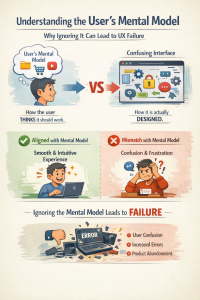
Mental Model is the users’ mental perception of how a system works.
Before using any digital product, users have certain expectations of it, based on their previous experiences.

In simple terms:

Users think about how the system “should” work, not how it is actually designed.

These mental models are usually formed from the following sources:

  • Experience using similar products
  • Common design patterns
  • The real world and physical objects
  • Language, culture, and everyday habits

The difference between a user's mental model and a designer's conceptual model

One of the most common problems in UX occurs when the user’s mental model is not aligned with the designer’s conceptual model.

  • Conceptual Model: How the designer or developer thinks the system works.
  • Mental Model: How the user thinks the system should work.

The greater the gap between the two:

  • The error rate increases
  • The harder it is for the system to learn
  • User satisfaction decreases

The Role of Mental Model in Gulf of Execution and Gulf of Evaluation

Donald Norman identifies two important gaps in user interaction with the system:

1. Gulf of Execution

  • The distance between:
  • The user’s goal
  • The actions the system provides to achieve that goal

If the user’s Mental Model is not aligned with the system, the user will not know what to do.

2. Gulf of Evaluation

The gap between:

  • System output
  • User perception of whether or not they achieved their goal

If the system feedback does not match the user’s subjective expectation, the user feels confused.

Practical example of Mental Model failure in UX

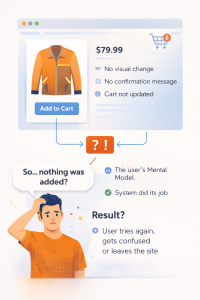
Let’s say a user visits an online clothing store and taps the “Add to Cart” button, but:

  • No visual change occurs
  • No confirmation message is displayed
  • The cart is not updated

In this case:

  • The user’s Mental Model says: “So nothing was added”
  • While the system has technically done its job

Result?
The user tries again, gets confused, or leaves the site.

How to identify users' mental models?

For Mental Model-based design, it is not enough to rely solely on guesswork and personal experience. The following methods are very effective:

1. User Interview

Ask questions like:

  • What did you think this section would do?
  • What did you expect to happen after this action?

2. Card Sorting

To understand how information is categorized from the users’ perspective.

3. Usability Testing

Observing actual user behavior, not what they say.

4. Analyze similar products

Examine patterns that users are already accustomed to.

Aligning the design with the users' mental model

To reduce the gap between the system and the user’s mind:

  • Use familiar patterns
  • Clear and predictable design
  • Use user-friendly language, not technical jargon
  • Quick and clear feedback for every action
  • Avoid unnecessary creativity in basic interactions

Mental Model and Business Success

Ignoring the Mental Model isn’t just a UX problem; it’s a business risk.

  • Products that align with users’ mental models:
  • Have higher conversion rates
  • Reduce user training costs
  • Increase user loyalty

Conversely, the more a user is forced to “think,” the more likely they are to abandon the product.

Conclusion

The user’s Mental Model is one of the most invisible but influential factors in user experience design. Good design is not necessarily complex or creative, but rather design that aligns with the way users think.

If your product is predictable, understandable, and aligned with users’ mental expectations, the path to success will be much smoother.

Written by uixpulse.com

Scroll to Top